Markup Language Comparison
This document compares HTML, Markdown, Asciidoc, and ReStructuredText (ReST) syntax for common elements. Each language has its strengths and typical use cases; choose the one that fits your tooling and audience.
- HTML is the standard markup for web pages; verbose but highly expressive.
- Markdown is lightweight and easy to read in plain text, popular on GitHub and many CMSs.
- Asciidoc offers more features than Markdown (tables, footnotes, includes) and is used for technical documentation.
- ReST is used by Python projects and Sphinx; it provides rich directives and is extensible.
Syntax Comparison Table
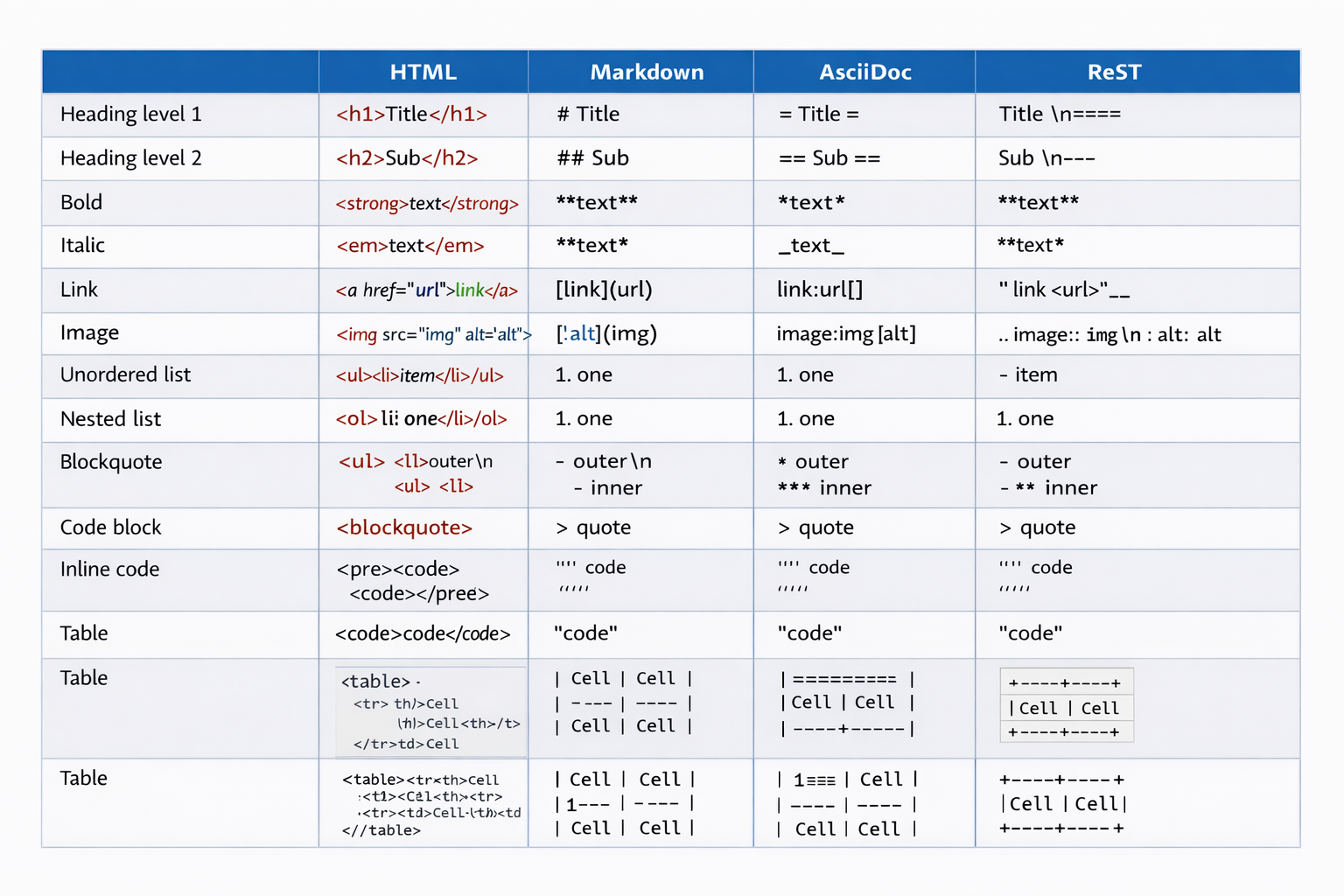
Block Elements
All four syntaxes support paragraphs separated by blank lines. HTML requires <p> tags, whereas the others do not.
Footnotes and References
- Markdown: limited support, often using extensions (e.g., [^1]).
- Asciidoc: built-in footnotes using footnote:[text].
- ReST: uses [1]_ notation with a corresponding footnote definition.
Pros & Cons
- HTML: powerful but not human-friendly to write manually.
- Markdown: easy for authors, but lacks advanced features without extensions.
- Asciidoc: a good balance for technical docs, with built-in features and conversion to multiple formats.
- ReST: excellent for documentation with Sphinx; learning curve steeper.
Feel free to extend this document with additional examples, directives, or language-specific idioms.